
A tree may spend decades growing in one place, but its journey begins much earlier. Before it becomes part of a forest, school, home, or community, it has already gone through several stages of growth and preparation. For many of the trees planted through Sumi Foundation, that journey begins long before planting day.
Where a Tree Begins
The first stage for many of our trees takes place in Sumi Foundation’s nursery. Seeds are raised there as they develop into young saplings. Sumi Foundation currently works with four kinds of trees: Beech, Tamarind, Teak, and Neem. This early stage gives the saplings time to grow before they are ready to be planted elsewhere.
Not every tree begins in our nursery. When additional trees are needed, Sumi Foundation also sources ready-to-plant saplings from other nurseries. Whether a tree begins with us as a seed or arrives as a young sapling, the next step is finding somewhere suitable for it to grow.
Ready for Planting
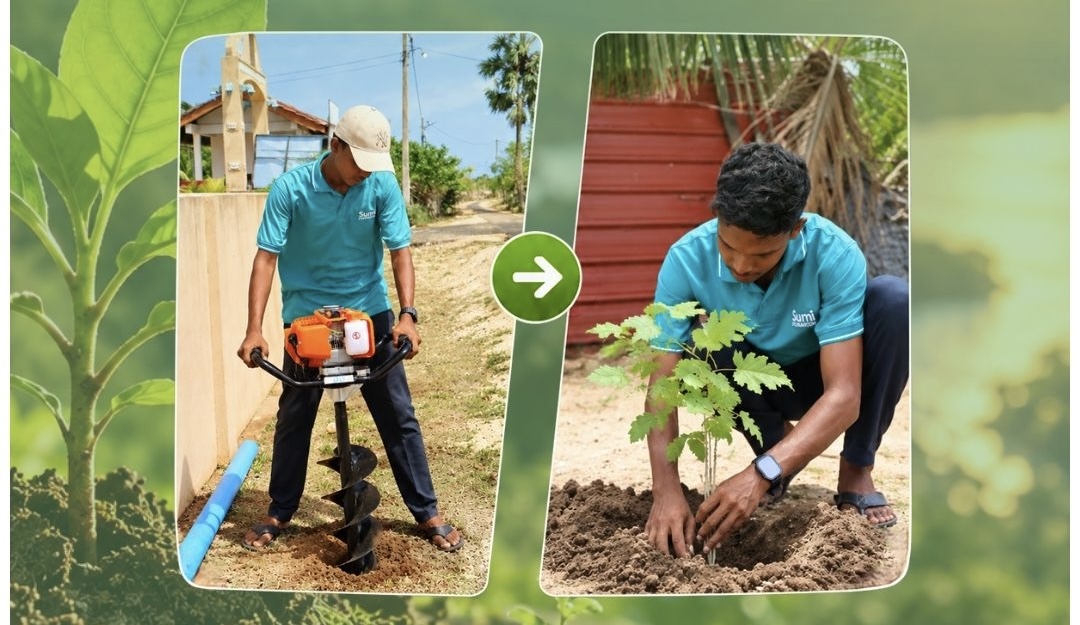
When a sapling is ready, it can be taken to a planting site. For some trees, that may be part of a reforestation area. Others may be planted near schools, homes, within local communities, or in other suitable locations across Sri Lanka. Where a tree is planted matters because that location will become the place where it continues to develop over time. Before the sapling can go into the ground, the planting site needs to be prepared.
Moving From Nursery to Soil
Where conditions allow, Sumi Foundation uses powered drilling equipment to prepare planting holes. This helps the team prepare larger areas more efficiently before planting begins. Once the ground is ready, the sapling can be placed into its new location. It is an important transition for a young tree. After growing in a nursery or arriving ready for planting, it now has a place in the soil where its roots can begin spreading into the surrounding ground.
The First Stages After Planting
A newly planted tree still needs time to adjust. Its roots are beginning to develop in a new environment, and access to water can be especially important during this stage. Sumi Foundation continues watering and caring for young trees for as long as needed after planting. Over time, the sapling can begin developing a stronger trunk, deeper roots, and a wider canopy. The benefits associated with mature trees take time to develop, which is why the early stages after planting are an important part of the process.
Another Way Trees Can Grow
Not every tree follows the nursery-to-planting-site route. Some areas suitable for reforestation are difficult to reach from the ground. In these locations, Sumi Foundation can use drones to carry and release seeds from above. Instead of first being raised as saplings in our nursery, these seeds are released directly into suitable areas where they may begin growing. This gives Sumi Foundation another way to support reforestation in places that are harder to access.
Trees in Schools and Communities
Some saplings also leave Sumi Foundation in the hands of schools and local communities. By providing trees for others to plant and care for, more people can become involved in the process. A tree planted near a school, home, or within a community can grow alongside the people who see it every day. Over time, it can become a lasting part of the place around it.
From One Tree to Thousands
Every tree starts small, with years of growth ahead of it. Some start as seeds in Sumi Foundation’s nursery. Others come from additional nurseries. Some are planted directly by our team, while others are provided to schools and communities. In harder-to-access areas, seeds may also be released from above using drones. The exact path may differ, but each one contributes to the same wider effort.
Sumi Foundation is committed to planting 50,000+ trees across Sri Lanka every year, with the goal of increasing that number as our environmental work expands. Behind that commitment are thousands of individual trees, each starting small and contributing to a much larger effort across Sri Lanka.
Author: Rabia Amjad
